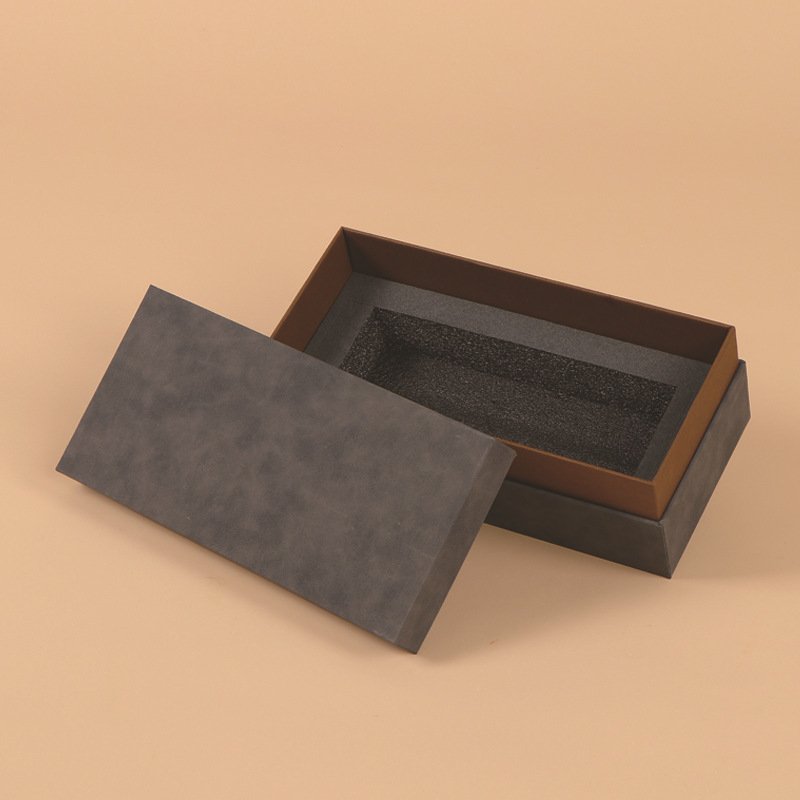
In the hyper-competitive world of consumer electronics, electronics packaging boxes are no longer just a box. It’s the first physical manifestation of your brand, a crucial marketing tool, and most importantly, the final line of defense for your product. For over a decade, BM has been crafting innovative paper-based packaging, displays, and gift boxes for industry leaders. We’ve watched the market evolve, but the current paradigm shift is the most profound: the industry is abandoning plastic.
The challenge is clear. For years, molded EPE foam, plastic trays, and bubble wrap were the “default” for electronic product inner protection. They are lightweight, inexpensive, and excellent at absorbing shock. But they are also a toxic legacy. Today’s consumers demand sustainability. Governments are introducing strict regulations on single-use plastics. You, the procurement manager or brand owner, are caught in a vise: how do you achieve 100% recyclability without sacrificing product safety? How can your sleek new smartphone, smart speaker, or premium headphones survive a 1.5-meter drop onto concrete when nestled in mere paper?
This is the dilemma that BM solves. We understand that “paper-based” cannot mean “weak.” It requires a new philosophy—engineering-first packaging design. We’ve compiled our a decade of expertise into this definitive guide to help you master the 1.5m drop test with completely plastic-free internal protection. We will move beyond the theoretical and provide practical, technical solutions you can implement today.
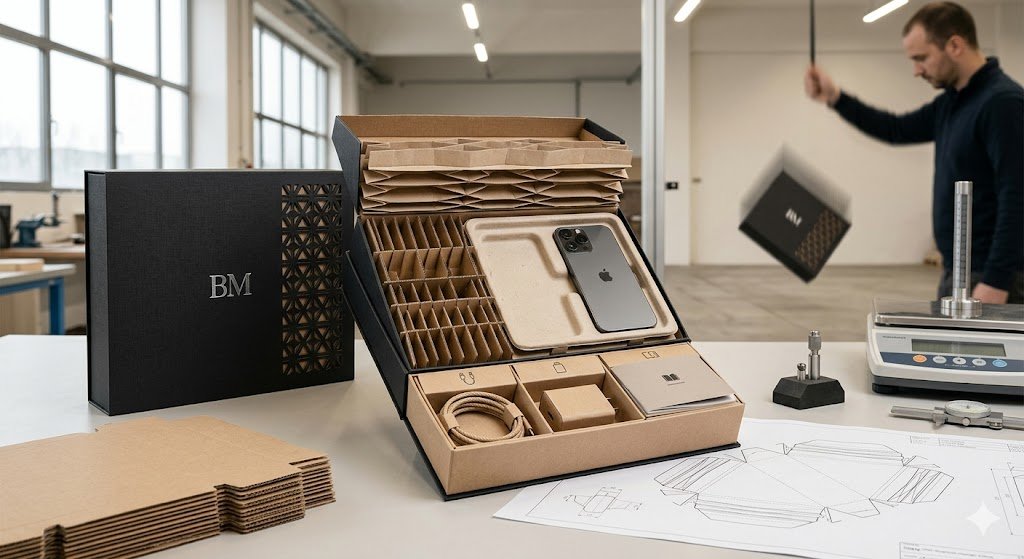
The New Paradigm: Why "Recyclable" Must Now Mean "All-Paper"
The term “sustainable” has been greenwashed into ambiguity. In the context of electronics packaging boxes, the only metric that matters in 2026 is circularity.
The Problem with Single-Use Plastic and Hybrid Inserts
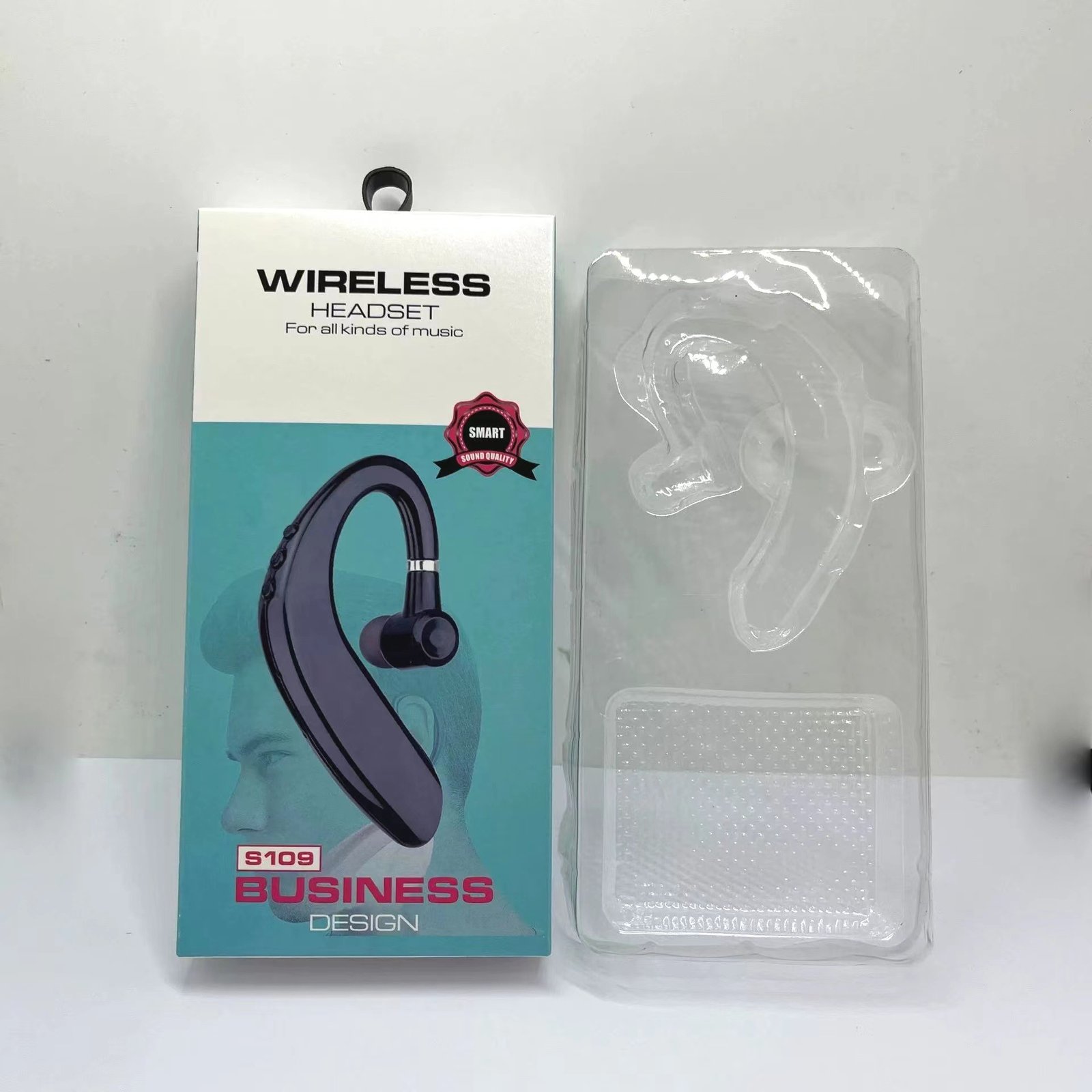
EPE (Expanded Polyethylene) and other petroleum-based foams are technically recyclable, but rarely recycled. Municipal facilities cannot process them economically. They break into microplastics, clog ecosystems, and end up in landfills. When you pair a beautifully printed paper box with a hidden plastic tray, you create a complex “multi-material” waste stream that forces the consumer to separate components. If they don’t, the entire package becomes unrecyclable.
This hybrid approach signals a disconnect: premium exterior, disposable interior. Your packaging must be a cohesive statement. To be truly recyclable, the entire structure—inner insert, outer box, and even the finish—must be compatible in a single waste stream. In the vast majority of markets, that means paper and cardboard.
The Rise of Eco-Regulations
The pressure is regulatory, not just emotional. The European Union’s PPWR (Packaging and Packaging Waste Regulation) is rapidly setting new standards for recycled content and recyclability. The empty space limit in packaging (often filled by oversized foam) is being slashed to 40% or less. If your packaging can’t integrate into existing paper recycling streams, your product may be subject to higher taxes or bans. A proactive transition to all-paper systems is the only long-term compliance strategy.
What the 1.5 Meter Drop Test Really Represents
The ISTA (International Safe Transit Association) 1.5-meter drop test is the gold standard because it simulates real-world logistics failures. A 1.5-meter drop mimics an accidental slip from a warehouse shelf, a delivery driver’s fumble, or the package tumbling off a residential porch.
For a sensitive electronic device, the danger isn’t just a cracked screen. The primary threats are deceleration trauma (the shock traveling through the components) and localized pressure (the box hitting a sharp corner and puncturing). Your non-plastic insert must perform three vital functions simultaneously:
Cushioning: Slowing down the product’s deceleration upon impact.
Immobilization: Preventing the product from rattling within the box.
Vibration Dampening: Absorbing high-frequency waves during transit.
Paper, if not engineered, is a poor cushion. But when structured, paper is an incredible material.
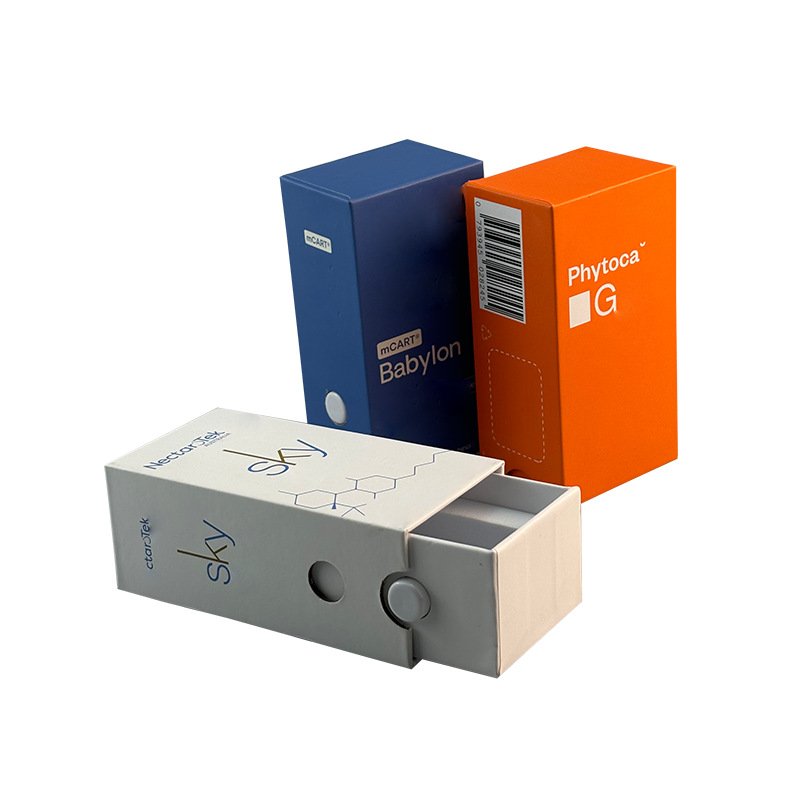
Engineering Solutions for All-Paper Internal Protection
At BM, we approach every new electronics project as a micro-engineering challenge. We don’t just “cut out a hole for the product.” We calculate energy dispersion. Here are the core techniques for achieving high-performance cushioning using only paper.
1. Molded Pulp (Fibre Moulding): The Ultimate EPE Replacement
For complex geometries and high-impact protection, molded pulp is the frontrunner. We create custom molds from recycled paper fibers (often kraft or sugarcane pulp) to create a protective cradle that perfectly conforms to your product.
Why it works for 1.5m drops:
Contoured Energy Absorption: A custom pulp tray grips the device firmly, preventing any pre-impact acceleration (rattling). When the outer box impacts, the pulp structure—which is designed with internal air pockets and ribs—compresses and flexes, absorbing a massive amount of kinetic energy before it reaches the electronics.
Localized Rigidity and Flex: We can engineer specific areas of the tray to be rigid (to hold components) and others to be more compliant (to cushion corners).
Key Implementation Note for Premium Electronics: Standard “egg carton” pulp is too rough for high-end tech. BM specializes in dry-press molded pulp and smooth-wall molded pulp. These are dense, structurally strong, and have a sleek, premium finish that will not scratch delicate finishes (though we sometimes add a glassine liner for extra insurance). The precision is sufficient to secure multiple components (cables, adapters) without them becoming dislodged.
2. Complex Corrugated and Cardboard Inserts (Dieline Magic)
For products that are more geometric, or for smaller production runs where pulp tooling is not cost-effective, engineered corrugated and cardboard dielines are powerful solutions.
Why it works for 1.5m drops:
Crush Zones: The core principle here is constructing defined ‘crush zones.’ These are strategically placed, empty, folded sections of cardboard surrounding the product. On impact, these folds buckle and compress. This controlled collapse is what absorbs the energy.
Interlocking Structures: A sophisticated dieline uses interlocking tabs and fins. These structures distribute the force across a much larger surface area. Rather than a corner taking 100% of the impact, the interlocking grid forces the entire insert to share the load.
BM’s Innovation: We utilize multi-layer corrugated (e.g., combining different flute types) to achieve specific cushioning goals. We often use F-flute for outer strength and finer G-flute or E-flute internally for precision and a smoother aesthetic. The design must be optimized to minimize empty space (PPWR compliant) while maximizing crushable volume.
3. Precision Honeycomb and Air-Gap Engineering
Sometimes, the simplest solution is the best. Honeycomb structures, derived from lightweight paper, offer incredible compressive strength and energy absorption.
Why it works for 1.5m drops:
The Shock-Absorbing Void: We often create inserts that are essentially frames. The product rests on a paper frame, but is surrounded by engineered air gaps. The primary drop force hits the outer box and then is transferred to the internal frame, which compresses. The critical electronic component never makes contact with the outer wall of the box.
This technique is excellent for flat devices like smartphones or tablets. By suspending the product away from all six faces of the exterior box, we ensure that a corner drop is absorbed by the surrounding cardboard structure before it can stress the device.
Step-by-Step Implementation: The BM Collaborative Process
As a manufacturer with a full design team, we don’t just produce your design; we optimize it. Transitioning away from plastic requires a structured, iterative process.
Step 1: Deep Product Analysis and Risk Assessment
We start by analyzing your product. What are the “kill points”? Is it the screen, the battery, or a sensitive internal PCBA? We define the failure criteria. For a smartwatch, a cracked lens is a failure; for a power bank, a dented casing may be acceptable, but a punctured battery is a catastrophic safety issue. We establish the required G-force tolerance for your device.
Step 2: Prototype and Dieline Engineering (3D Mockups)
Our structural designers create multiple concepts. For an all-paper solution, the initial dieline is critical. It must minimize glue points (for easier recycling) and facilitate fast assembly on your production line. We generate detailed 3D mockups and CAD dielines for your review. This is where we define the exact geometry for the crush zones or air gaps.
Step 3: Prototyping and White-Sample Drop Testing
We don’t wait for your final art. We produce physical “white samples” using the exact materials (paper grade, flute type) specified in the design. We perform initial in-house drop tests. We will drop a simulated weight or a dummy product to observe the performance of the pulp or cardboard structure. If the initial insert fails or allows too much movement, we iterate immediately—stiffening a tab, adding a fold, or deepening a pulp rib.
Step 4: Full Validation at a Third-Party Lab
For full product verification, we facilitate third-party laboratory drop testing. This provides independent validation that your packaging meets the ISTA 1.5m standard. This certification is a valuable asset for global distribution and retail partners.
Step 5: Optimization for Assembly Line and Shipping
An effective insert is useless if it takes too long to assemble or costs too much to ship. We optimize the design for “pack out.” This means ensuring the insert is intuitive for your assembly workers and doesn’t require complex folding. Furthermore, we design all-paper systems to stack and ship efficiently. For example, our custom rigid boxes with folding pulp inserts are designed to ship flat-packed wherever possible to minimize volume weight.
Part 4: Frequently Asked Questions & Critical Considerations for Tech Brands
When our electronics clients make this switch, they invariably have the same questions. Here are our insights from over a decade of production.
“Will an all-paper insert cost more than plastic/EPE?”
This is the most common concern. The initial unit cost of a dry-press pulp tray may be slightly higher than a simple EPS (Expanded Polystyrene) shape. However, you must consider the Total Cost of Packaging. An all-paper solution often saves money by:
Reducing regulatory taxes.
Lowering shipping volume weights (as we eliminate the excessive empty space required by foam).
Facilitating flat-packing.
Improving brand perception (which justifies a premium product price).
BM’s mission is to make sustainable solutions competitive through intelligent, optimized design.
“Does paper provide the same moisture and anti-static protection as plastic?”
It can. We offer paper-based anti-static (ESD) coatings for cardboard inserts that are safer for sensitive PCBA components than traditional anti-static plastic bags, which can degrade. For high-humidity environments, we use moisture-resistant additives in our pulp formulas and specific moisture-barrier paper for outer boxes. The myth that paper cannot handle the elements has been debunked by engineered material science.
“How do I ensure a ‘premium unboxing’ without plastic trays?”
A common misconception is that “sustainable” means “cheap looking.” In fact, paper offers more avenues for luxury finish than plastic. We focus on:
Surface Texture: Smooth-wall pulp with a soft-touch or matte finish.
Die-Cutting and Layering: Creating a sophisticated, architectural “lift-out” experience, where components reveal themselves in a deliberate sequence.
Finish Alignment: Ensuring the color and finish of the inner insert perfectly complement the outer rigid box or gift bag, creating a unified brand statement.
An all-paper insert that fits perfectly and opens smoothly communicates a high-end, thoughtful, and modern brand far better than a crude piece of foam.
“What if my production volumes are low? Is pulp still an option?”
Dry-press pulp has high tooling costs. If your SKU has a low forecast, we will recommend an advanced corrugated dieline structure. We have perfected designs that offer pulp-level protection using only intelligent folds and crush zones, which can be produced with very low setup costs.
Partner with BM to Lead the Non-Plastic Revolution
The future of electronics packaging boxes are circular. The brand that masters the 1.5m drop test with 100% paper-based solutions will gain an immediate, quantifiable advantage in market share, regulatory compliance, and brand loyalty. The complexity of this engineering challenge is real, but it is a challenge that BM is built to solve.
With over 10 years of experience, we don’t offer generic advice; we provide validated, technical solutions tailored to your product. We have helped dozens of electronics brands navigate this exact transition, from initial concept to a certified, market-ready package.
Don’t wait for a new regulation or a wave of negative consumer reviews. Contact BM today. Our team will review your current product and provide a feasibility assessment for an engineered, plastic-free protective solution that not only survives the 1.5m drop test but defines your brand as a sustainable leader. The change is coming. Be the brand that defines it.
About BM Paper Box Manufacturer
We are a professional paper packaging box customization factory with ten years of industry experience. We focus on providing customers with high-quality customized packaging solutions, covering consumer electronics, medical equipment consumables, cosmetics and other fields, with ingenious design and exquisite technology, to add infinite charm to customers’ products.
As a professional paper packaging box customization factory, our service range is wide, covering consumer electronics, medical equipment consumables, cosmetics and other fields. Whether it is the exquisite gift box of high-end consumer electronics, the professional packaging of medical equipment, or the fashion outer box of cosmetics, we can tailor the most suitable packaging solution according to the needs of customers and the characteristics of the product. Our professional strength has been recognized by many brand customers and become their trusted partner.
Why Choose BM Paper Box Factroy
HIGH END QUALITY:As one of the best customized paper box manufacturer in china, our QC team will ensure every single product you receive are best quality. We have professional quality testing machine.
PRODUCT DESIGN:Our sampling department has complete process of making drawings into reality. We also improve your product design based on our years of working experience.Tell us what you think.
STABLE DELIVERY TIME:As the best gift box manufacturer & supplier,we have sufficient manufacturing capacity, big orders won’t beat us, we can still deliver the order for you in time.
BEST PRICE:We are source factory of paper boxes and the best manufacturer in China, that’s why we can provide high quality bags with best price.
PRECISE MANAGEMENT:Nothing can be achieved if we don’t implement precise management. We are a company with complete management system.
7-24 SERVICE:As the best paper box manufacturer, 24-7 immediate response: We’ll receive your feedback to make us a better supplier.contact us(+86 18925520049)
FAQs About BM Paper Box
We are a Chinese top manufacturer and our factory is located in Dongguan. Welcome to visit our factory!
• We are a professional paper packaging product provider, especially in the gift packaging field. We can produce kinds of paper boxes and paper bags for multi-purpose.
• We provide one-stop services and accept custom designs as your requirements.
•Of course, usually we will provide free samples, and you only need to cover the freight. For custom printed samples, pls send your requirements to us for checking the sample cost.
• It takes about 7 days for sample production.
Yes, we provide free design services, structural design and simple graphic design.
Sure. We can do any packaging with your design. Now we open a ODM packaging which is for small quantity from 100pc to 500pc,but you can still have your own logo.
Depending on the order quantity and production details, it will take about 15 to 20 days.
Always a pre-production sample before mass production; Always final Inspection before shipment
• Size, material, printing details, quantity, shipping destination, etc.
• You can also just tell us your requirements and we will recommend products to you.
• By sea, by air or by express.
• If you have your own freight forwarder in China, it is the ex-factory or FOB price.
•CFR or CIF, etc., if you need us to ship on your behalf.
• DDP and DDU can also be used.
• More choices, we will consider your choices.
• The price is determined by the quantity, material, processing method, size and other factors. In addition, due to our continuous
technological innovation, the prices of some of our products are extremely competitive, please contact us to quote.